

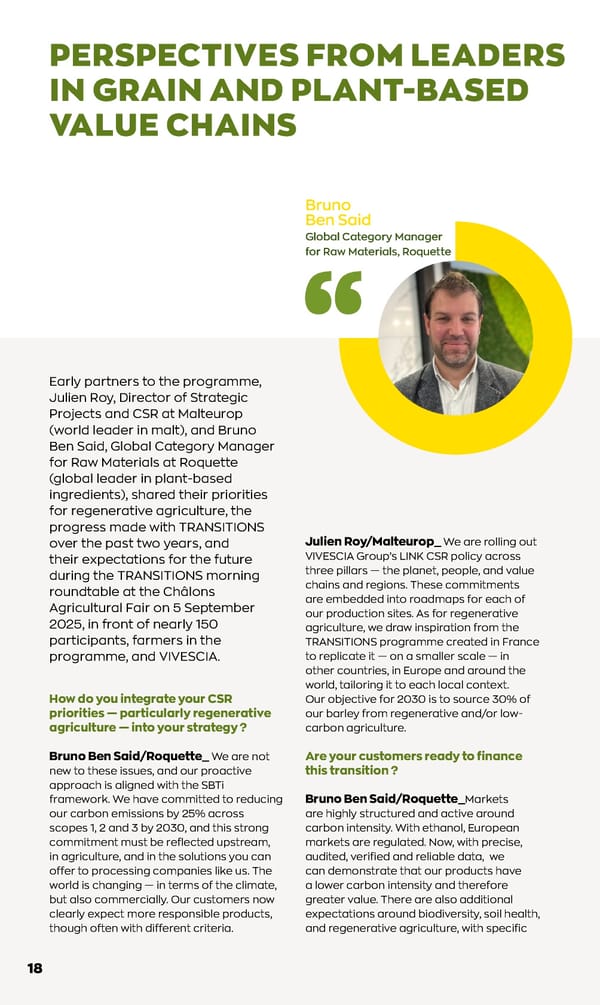
Bruno Ben Said Global Category Manager for Raw Materials, Roquette PERSPECTIVES FROM LEADERS IN GRAIN AND PLANT-BASED VALUE CHAINS Early partners to the programme, Julien Roy, Director of Strategic Projects and CSR at Malteurop (world leader in malt), and Bruno Ben Said, Global Category Manager for Raw Materials at Roquette (global leader in plant-based ingredients), shared their priorities for regenerative agriculture, the progress made with TRANSITIONS over the past two years, and their expectations for the future during the TRANSITIONS morning roundtable at the Châlons Agricultural Fair on 5 September 2025, in front of nearly 150 participants, farmers in the programme, and VIVESCIA. How do you integrate your CSR priorities — particularly regenerative agriculture — into your strategy ? Bruno Ben Said/Roquette_ We are not new to these issues, and our proactive approach is aligned with the SBTi framework. We have committed to reducing our carbon emissions by 25% across scopes 1, 2 and 3 by 2030, and this strong commitment must be reflected upstream, in agriculture, and in the solutions you can offer to processing companies like us. The world is changing — in terms of the climate, but also commercially. Our customers now clearly expect more responsible products, though often with different criteria. Julien Roy/Malteurop_ We are rolling out VIVESCIA Group’s LINK CSR policy across three pillars — the planet, people, and value chains and regions. These commitments are embedded into roadmaps for each of our production sites. As for regenerative agriculture, we draw inspiration from the TRANSITIONS programme created in France to replicate it — on a smaller scale — in other countries, in Europe and around the world, tailoring it to each local context. Our objective for 2030 is to source 30% of our barley from regenerative and/or low- carbon agriculture. Are your customers ready to finance this transition ? Bruno Ben Said/Roquette_ Markets are highly structured and active around carbon intensity. With ethanol, European markets are regulated. Now, with precise, audited, verified and reliable data, we can demonstrate that our products have a lower carbon intensity and therefore greater value. There are also additional expectations around biodiversity, soil health, and regenerative agriculture, with specific 18
 TRANSITIONS - Everything begins together Page 19 Page 21